

Industry has never generated as much data as it does today. Sensors, machines, corporate systems, ERPs, IoT devices, and monitoring platforms continuously generate information throughout the entire operation. Even so, many companies still struggle to make faster decisions, reduce waste, and improve operational efficiency.
The issue is not necessarily the lack of technology, but the fragmentation of information.
A large portion of industrial operations still relies on manual processes, disconnected spreadsheets, and isolated data flows that do not communicate with each other. The result is an environment where critical decisions continue to be made based on incomplete, outdated, or unreliable information.
And the numbers show that this scenario comes at a high cost.
The hidden cost of “analog” decisions
According to the global research The 2025 State of Data Analysts in the Age of AI, 76% of analysts still rely on spreadsheets for data preparation tasks. In addition, nearly half of the professionals surveyed reported spending more than six hours per week manually cleaning and organizing information.
More than an operational issue, this represents a strategic risk. Manual processes significantly increase the likelihood of inconsistencies and reduce the reliability of data used in automation, analytics, and artificial intelligence initiatives.
In practice, companies seeking to accelerate their digital transformation continue to support part of their operations with structures that were never designed for real-time decision-making.
Another relevant figure comes from Autodesk’s 2024 study, The Digital Factory: A Data Story. According to the report, 70% of companies still use spreadsheets to develop and operate their factories. Approximately 95% of the data generated during the construction and planning of an industrial plant is never used during operations.
This means valuable information is lost before generating any productive impact.
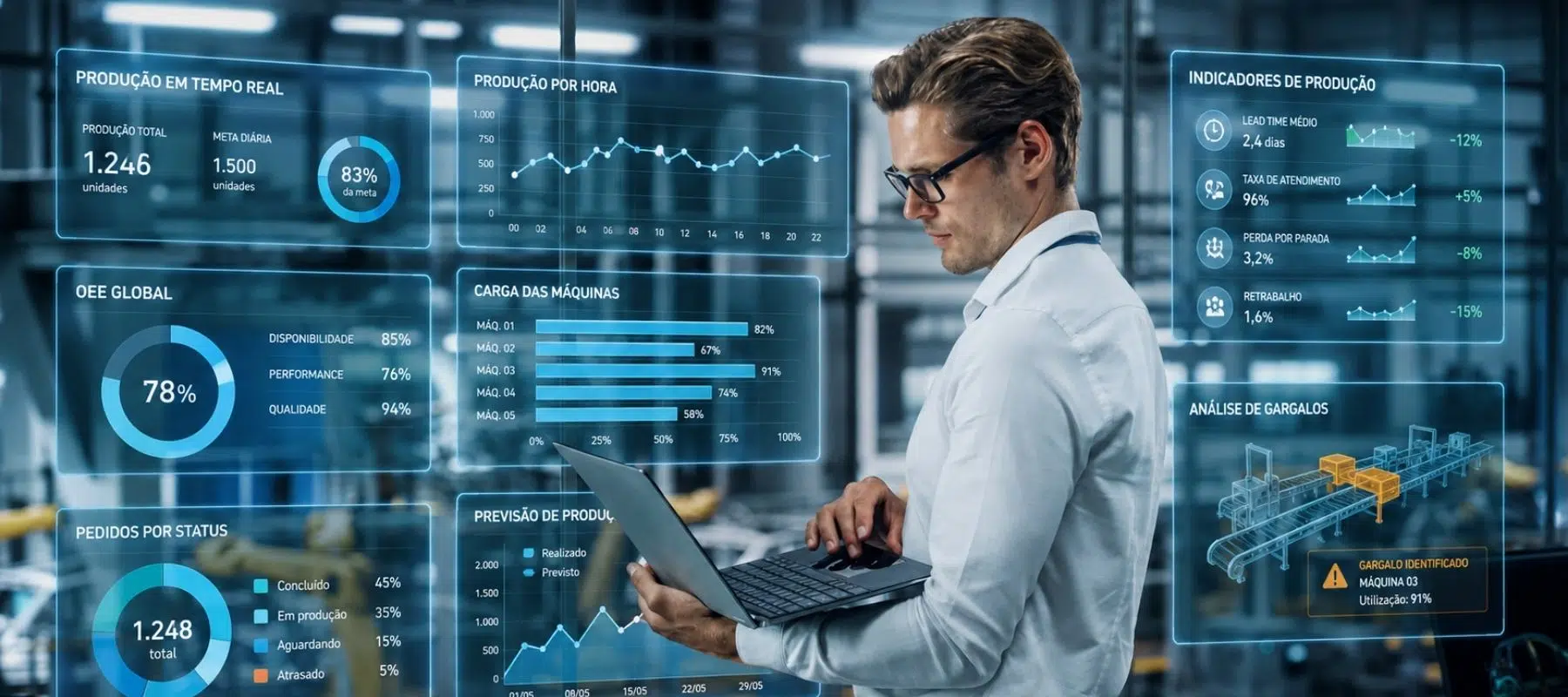
When information arrives too late, operations lose efficiency
In modern industrial operations, responsiveness has become a competitive advantage. The problem is that many factories still operate with slow update cycles, where information is consolidated only on a daily or weekly basis.
Recent studies published in the Flexible Services and Manufacturing Journal (2024) demonstrate the direct impact of real-time data updates on operational indicators.
In certain production control models, increasing the frequency of information updates improved machine utilization by up to 91.5%. In KANBAN-based systems, real-time data reduced Lead Time by more than 34%.
These results show that the gain is not simply in “visualizing data,” but in enabling the factory to continuously respond to what is happening in the production process.
This is where MES solutions begin to play a strategic role.
MES as the backbone of industrial operations
The concept of MES, Manufacturing Execution System, has evolved significantly in recent years.
Previously seen only as a production monitoring tool, MES has become a central operational orchestration system, connecting machines, people, processes, and enterprise systems into a single information flow.
According to studies published in the Decision Analytics Journal (2025), approximately 59% of Industry 4.0 information management studies indicate that central systems such as ERP and MES should act as interoperability mediators between sensors, IoT devices, and industrial systems.
In practice, this means transforming fragmented architectures into integrated environments capable of delivering reliable and actionable real-time data.
More than centralizing information, MES creates a “digital nervous system” for the factory.
From passive monitoring to active operational intelligence
Many companies believe they already have a Digital Twin simply because they monitor equipment through dashboards. However, recent studies show there is a significant difference between a “Digital Shadow” and a true “Digital Twin.”
In a Digital Shadow model, data flows in only one direction: from the machine to the system. There is visibility, but no real capability for intelligent action.
In a Digital Twin model, however, data flows bidirectionally and continuously. The system receives operational data, processes information in real time, and generates recommendations, adjustments, or automated responses to optimize production processes.
Research published in Applied Sciences (2025) shows that predictive models powered by industrial data can reduce analyses that previously took minutes or hours to fractions of a second, enabling instant decisions and continuous optimization.
This shift completely redefines how industries operate.
The focus is no longer just on “monitoring indicators,” but on continuously acting upon them.
The future of industrial efficiency depends on connected data
Manufacturing digital transformation does not happen solely through the adoption of new technologies. It depends primarily on the ability to integrate information, eliminate silos, and transform operational data into actionable intelligence.
Companies that continue to rely on spreadsheets, manual controls, and disconnected systems will face increasing difficulty scaling productivity, responding quickly to operational changes, and sustaining advanced automation and artificial intelligence initiatives.
The current industrial challenge is not generating more data.
It is being able to use data in an integrated, reliable, and real-time manner.
Transform operational data into faster and more strategic decisions
Smart Logic MES, a solution by EYF Solutions, connects machines, systems, and processes into a single platform, providing real-time operational visibility, traceability, integration, and intelligence for industrial decision-making.
Discover how Smart Logic MES can elevate the efficiency and control of your operations.
