
For decades, headcount optimization in industry was strongly associated with cost reduction and operational labor control. In many cases, initiatives were conducted with an almost exclusive focus on reducing teams or limiting the growth of operational structures, without considering broader impacts on productivity, flexibility, capacity utilization, and operational sustainability.
With the evolution of new technologies such as Artificial Intelligence, Machine Learning, and Digital Twins, this scenario has started to change significantly. Industry has begun adopting a much more strategic and data-driven approach, where headcount optimization is no longer limited to workforce reduction and instead becomes connected to productivity, efficiency, intelligent resource utilization, and dynamic workforce planning.
This shift is already generating significant impacts across multiple industrial sectors. Recent studies indicate that Strategic Workforce Planning initiatives can generate average savings of 10% in annual labor budgets through lower turnover, improved resource allocation, and higher production efficiency. At the same time, Artificial Intelligence is estimated to have the potential to add up to US$4.4 trillion in global productivity growth over the long term.
The transformation of the traditional headcount model
Historically, industrial headcount planning was structured around relatively rigid models based on fixed positions, static organizational structures, and linear workforce growth. This model was suitable for more predictable environments with lower operational variability and lower production complexity.
However, today’s industrial environment operates under far more dynamic conditions, characterized by constant demand fluctuations, frequent product mix changes, capacity constraints, increasing pressure for efficiency, and the need for rapid responses to operational changes.
In this context, many organizations are shifting from traditional “headcount planning” toward “skill-based workforce planning” models. In practice, this means planning is no longer focused solely on how many employees are required, but rather on the critical capabilities needed to sustain future operations.
Instead of simply filling positions, companies are evaluating which capabilities need to be developed, automated, redistributed, or strategically complemented. As a result, headcount optimization is increasingly treated as an integrated strategy for productivity, industrial capacity, and intelligent resource utilization.
The role of Artificial Intelligence in workforce optimization
The application of Artificial Intelligence in industrial workforce management is accelerating this transformation. Machine Learning and Reinforcement Learning models are already being used to forecast operational demand, balance workloads, optimize schedules, reduce manual activities, and improve the utilization of production resources.
Unlike traditional methods, which typically rely on fixed rules or static analyses, AI models can continuously learn from operational data. This enables more adaptive and precise decision-making based on demand changes, resource availability, and production constraints.
Recent studies demonstrate that Reinforcement Learning models can:
- improve task allocation accuracy by 18%
- reduce scheduling conflicts by 22%
- increase employee satisfaction by 15%
In addition, intelligent models significantly outperform traditional approaches because they can simultaneously evaluate multiple operational variables and identify more efficient workforce allocation combinations.
While conventional methods typically operate with limited adaptability, AI-based algorithms can continuously recalculate scenarios, anticipate production impacts, dynamically balance workloads, and optimize capacity utilization in real time.
As a result, efficiency gains can reach approximately 85%, compared to around 70% in traditional models, while operational balancing effectiveness can approach 90%.

Digital Twins and industrial operation simulation
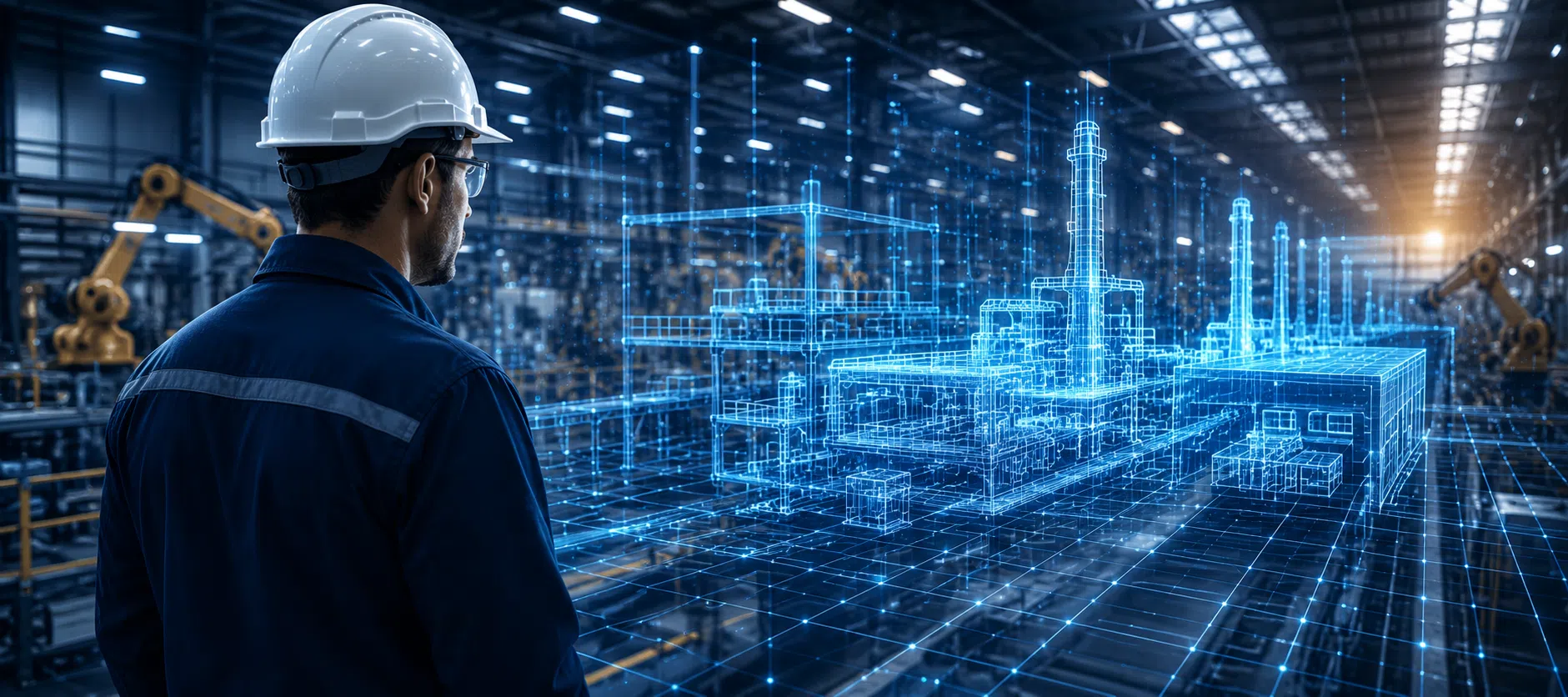
At the same time, Digital Twins are playing a central role in the evolution of headcount optimization in industry. Far beyond process visualization, digital twins enable the creation of complete virtual representations of industrial operations by integrating production, logistics, material handling, production resources, workforce behavior, and operational variability into a single analytical environment.
This allows companies to simulate scenarios before physical implementation, reducing risks and significantly increasing decision-making accuracy related to production capacity and resource utilization. When applied to workforce optimization, Digital Twins enable companies to simulate different workforce allocation strategies, validate automation impacts, predict production bottlenecks, analyze utilization levels, and test industrial expansion scenarios before real-world implementation.
In practice, this enables decisions related to capacity expansion, layout modifications, shift changes, or automation initiatives to be evaluated with much greater predictability and confidence.
The challenges of scaling headcount optimization
Despite technological advancements, many organizations still face challenges in scaling AI- and Digital Twin-based headcount optimization initiatives consistently across industrial operations. The main challenge is not simply implementing the technology itself, but expanding these initiatives across multiple plants, production lines, and operational areas in an integrated way.
Among the main barriers identified are legacy system integration, cultural resistance to change, lack of structured data, low analytical maturity, and difficulty integrating operational areas.
In addition, many organizations still do not consider themselves fully prepared to incorporate AI consistently into day-to-day operations, demonstrating that transformation depends not only on technology adoption, but also on the organizational capability to structure data, integrate processes, and embed analytical intelligence into decision-making.
The future of headcount optimization in industry
The evolution of headcount optimization in industry is directly connected to companies’ ability to integrate new technologies into strategic productivity and capacity decisions.
In this new landscape, AI and Digital Twins enable industries to simulate future operations, validate strategies before implementation, optimize workforce allocation, reduce manual effort, and increase productivity with greater predictability.
The future of headcount optimization in industry will not be defined solely by automation, but by the ability to transform data, analytical intelligence, and advanced simulation into faster, more efficient, and more sustainable decisions across the entire operation.
