

Order picking is one of the most labor-intensive and costly activities within a warehouse. A literature review published in the European Journal of Operational Research estimates that picking can account for up to 55% of total warehouse operating costs.

As e-commerce volumes increase, SKU counts grow, and labor availability becomes more challenging, logistics managers face mounting pressure to achieve higher throughput using the same physical footprint and headcount, without relying on unlimited investments in infrastructure and automation.

In this context, defining picking strategies, designing layouts, and optimizing flows become important levers for improving performance. Technologies such as Digital Twin, Artificial Intelligence, and Machine Learning enhance this capability by enabling the analysis of large volumes of data, the evaluation of different configurations, and the identification of optimization opportunities before changes are implemented in the physical environment.

Picking as a Driver of Warehouse Efficiency

Picking efficiency is directly related to variables such as travel distance, the number of orders processed simultaneously, product location, and resource utilization. The literature on warehouse picking highlights decisions related to layout, storage assignment, routing, batching, and zoning as fundamental elements in the design and control of these processes.

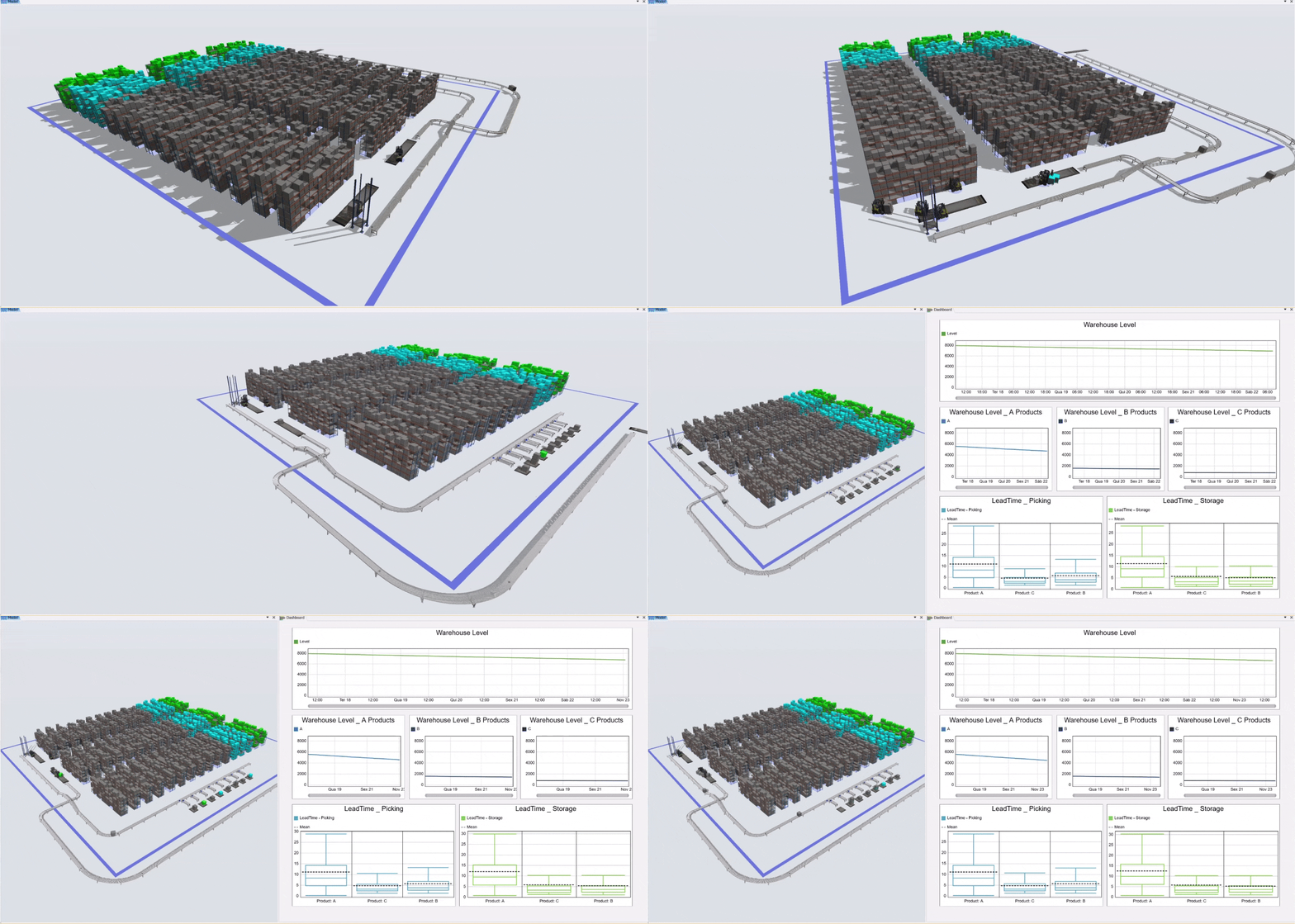
These are precisely the types of variables where a Digital Twin can generate value. By creating a digital representation of processes, flows, resources, and constraints, different strategies and configurations can be evaluated, their impacts measured, and more efficient alternatives identified before changes are implemented in the physical environment.
Batching and Routing: Interdependent Decisions in the Warehouse

The way orders are grouped and picking routes are defined has a direct impact on travel distances, productivity, and processing times within the warehouse.

Batching consists of grouping two or more orders so that they can be picked within the same route, rather than performing an independent route for each order. Academic literature recognizes this strategy as a way to reduce travel time and distance, particularly when orders contain items stored in nearby locations.

Routing, in turn, determines the sequence of locations that must be visited during the picking process. These two decisions are directly related: the composition of a batch changes the locations that need to be visited and, consequently, influences the most efficient route for completing the picking process.

For this reason, research has increasingly focused on the joint optimization of batching and routing. Studies published in the European Journal of Operational Research and Computers & Operations Research demonstrate the importance of considering these variables simultaneously to minimize picking distances, rather than treating them as independent decisions.

Another relevant concept is wave picking. In this model, orders are organized into groups that are released for picking within defined time windows, considering factors such as priority, shipping schedules, available capacity, and carrier cut-off times. The composition and size of these waves directly influence resource utilization and internal warehouse flows.

AI and Digital Twin Applied to Warehouse Optimization

Advances in Artificial Intelligence, Machine Learning, and Digital Twin are expanding the ability to analyze complex logistics systems and identify efficiency opportunities across an increasing number of variables.

These technologies can support decisions related to picking, routing, batching, SKU allocation, replenishment, and resource utilization, considering not only each element individually but also their interdependencies. This approach is particularly relevant to fulfillment processes, which encompass the steps required to complete an order, from processing and picking through preparation for shipment.

Recent studies demonstrate relevant results from this integration. Research published in 2026 developed a Digital Twin system to analyze demand patterns and support slotting decisions by integrating data with digital models. In the context analyzed, the approach delivered a 42% increase in productivity, measured by pallets processed per hour, and a 41% reduction in shipping time.

Research is also moving toward increasingly integrated analysis. Changing the location of specific SKUs, for example, can affect travel distances, influence batch composition, change optimal picking routes, and impact resource utilization. In this context, AI, Machine Learning, and Digital Twin expand the ability to evaluate these variables simultaneously and compare different configurations before implementation.

Digital Twin as a Decision-Making Environment for the Warehouse

Within a warehouse, decisions related to slotting, picking, batching, zone sizing, layout, capacity, and resource allocation are interdependent. Changing the location of SKUs may reduce travel distances while simultaneously creating new operational inefficiencies or altering the distribution of flows. Evaluating these decisions in an integrated manner is therefore essential to understanding their impact on overall system performance.

A Digital Twin enables processes, resources, constraints, demand, and the physical characteristics of the environment to be digitally represented so that different configurations can be evaluated before implementation. This makes it possible to measure their impact on indicators such as travel distance, picking time, queues, resource utilization, throughput, capacity, and service levels.

This approach can also support CAPEX validation for the design, expansion, or modernization of warehouses. Different alternatives involving layouts, storage structures, docks, equipment, picking areas, and capacity can be evaluated before capital is committed, making it possible to determine whether the proposed configuration can support expected demand, anticipate bottlenecks, and properly size the required resources.

A digital warehouse design case documented in 2020 used digital tools to develop detailed OPEX and CAPEX estimates and compare manual and automated solutions. In the case presented, the company was able to reduce planned CAPEX by approximately 10% and operating expenses by more than 30%. The same approach enables layouts, flows, picking methods, and labor and equipment requirements to be evaluated before physical implementation.

The integration of Digital Twin with advanced optimization methods has also produced relevant recent results. In a study published in 2026, an algorithm integrated into a Digital Twin-aligned environment was evaluated across scenarios involving 50 to 300 orders. The approach achieved a 14.7% to 17.2% reduction in total picking time compared with the standard algorithm and an approximately 30% to 42% reduction in average picker waiting time compared with the best benchmark used in the study.

Digital Twin can therefore serve as a decision-making environment for warehouse management, enabling organizations to anticipate operational inefficiencies, validate capacity, size resources, and evaluate different CAPEX alternatives before changes and investments are implemented in the physical environment.

From Digital Analysis to Warehouse Optimization

EYF Solutions’ capabilities based on Digital Model, Digital Shadow, Digital Twin, Artificial Intelligence, and Advanced Analytics make it possible to represent the specific characteristics of each warehouse and evaluate different combinations of batching, routing, slotting, layout, capacity, and resource allocation. Using real-world data, different scenarios can be compared based on indicators such as throughput, productivity, resource utilization, travel distances, and waiting times.

With this approach, optimization decisions no longer rely solely on benchmarks and instead take into account the interdependencies within each environment. EYF Solutions supports companies in modeling, analyzing, and validating alternatives before implementation, helping reduce uncertainty, optimize resources, and provide a stronger analytical basis for improvement and investment decisions. Contact us.

References

DE KOSTER, R.; LE-DUC, T.; ROODBERGEN, K. J. Design and control of warehouse order picking: A literature review. European Journal of Operational Research, v. 182, n. 2, p. 481–501, 2007.

BRIANT, O.; CAMBAZARD, H.; CATTARUZZA, D.; CATUSSE, N.; LADIER, A.-L.; OGIER, M. An efficient and general approach for the joint order batching and picker routing problem. European Journal of Operational Research, v. 285, n. 2, p. 497–512, 2020.

AERTS, B.; CORNELISSENS, T.; SÖRENSEN, K. The joint order batching and picker routing problem: Modelled and solved as a clustered vehicle routing problem. Computers & Operations Research, v. 129, 105168, 2021.

ZHANG, J. Intelligent warehouse supply chain order picking optimization based on digital twin and genetic algorithm. Discover Applied Sciences, 2026.

TAQUÍA GUTIÉRREZ, J. A.; MACHUCA DE PINA, J. M. Smart Warehouse Management Using Digital Twins and Machine Learning. South African Journal of Industrial Engineering, v. 37, n. 1, p. 17–27, 2026.

BUSTAMANTE, F.; DEKHNE, A.; HERRMANN, J.; SINGH, V. Improving warehouse operations—digitally. 2020. Industry reference on digital warehouse design, layout evaluation, resource sizing, and CAPEX/OPEX validation.

Michael Machado

CEO at EYF | Experiencing the future with Digital Planning, Risk-Based Management, AI and Advanced Analytics.


Consulting in Digital Transformation & Planning and Development of Customized Solutions.

website by